
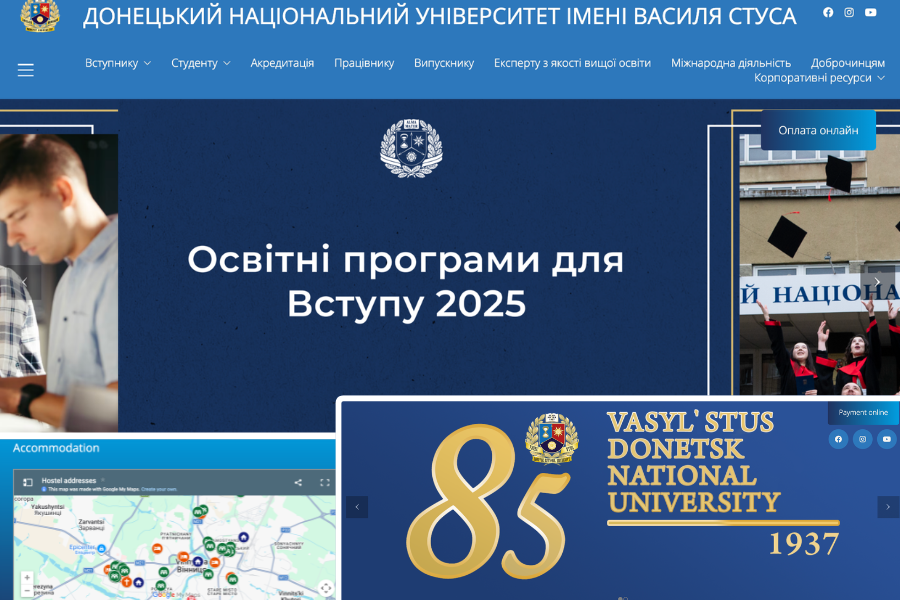
Relocated universities in Ukraine
M.I.
Academic Freedom Amidst Air Raid Alerts
War transforms not only political reality, but also the functioning of foundational social institutions. In this context, universities become increasingly vulnerable spaces.
As opposed to physical infrastructure, academic freedom cannot be restored automatically, simply by decree or through funding. It requires targeted support and reconceptualization.
Before the start of the full-scale war, academic freedom in Ukraine was primarily associated with professional autonomy: the ability to freely choose research topics, disseminate scientific ideas, and work without the constraints of censorship. It was viewed as a hallmark of a mature academic environment and open intellectual exchange.
With the outbreak of the war, this understanding broadened. It became evident that access to education is, in itself, a crucial dimension of academic freedom. Amidst air raid alerts and security threats, the standard way of conducting instructional and research activities becomes difficult, even impossible.
This is particularly evident in frontline regions, where educational practices are adapting to the new reality: classes are moving into shelters, hybrid formats are used, and alternative methods for maintaining the educational process are being established.
Relocation of Higher Education In the Face of Armed Aggression
The concept of “displaced universities” appeared in Ukrainian legislation virtually as soon as the phenomenon itself arose.
According to the Law of Ukraine “On Higher Education,” a temporarily displaced higher educational institution is an institution that, due to temporary occupation or hostilities, has changed its location and continued its operations in territory controlled by Ukraine.
It is important to note that this does not refer to creating a new university, but to preserving the existing institution: the university is not dissolved and retains its legal status, licenses, and accreditation, yet it operates in a different city or region.
A Wartime Phenomenon
The phenomenon of displaced universities is not new to world history.
Relocation was a common practice during WWI and WWII, when states whose territories had been occupied or become combat zones relocated some of their universities and other educational institutions to safer regions in order to preserve the educational process and scientific activities.
At the same time, the situation in Ukraine has its own specific characteristics linked to the scale of displacement, the duration of the war, the waves of occupation, and the hybrid formats adopted by universities. Many higher education institutions are compelled to combine in-person, remote, and distributed learning, operate simultaneously across multiple cities, or maintain the educational process despite partially destroyed infrastructure and constant security threats.
In Ukraine, universities were displaced as a result of two waves of Russian aggression:
- The first wave (starting in 2014) was associated with the annexation of Crimea and the occupation of part of the Donetsk and Luhansk regions.
- The second wave (starting in February 2022) was caused by Russia’s full-scale invasion of Ukraine.
These two stages differ significantly in both the scale and the operational models of the displaced universities.
In the hybrid warfare period, relocation primarily followed the “full-scale” model, entailing the mass relocation of faculty, students, and administrative staff to Ukrainian-controlled territory. Fourteen universities relocated during this time. For many students and staff, the move meant not only a change of workplace or place of study, but also actual migration alongside the university community. Those who remained in the occupied territories or went abroad could generally continue their studies only through correspondence or distance learning.
After the start of the full-scale invasion in 2022, the nature of the relocation changed significantly, predominantly adhering to a “semi-virtual” model: only a portion of the administration and a limited number of staff relocated physically, while the educational process continued online, regardless of the physical location of faculty and students.
Exceptions were made for certain fields of study—primarily medical and some technical disciplines—where fully remote instruction was not feasible. During this period, around 30 universities were relocated.
A distinct subtype of the second wave was “re-relocation”—a situation in which universities that had already been displaced after 2014 were forced to move again due to ongoing hostilities or the occupation of their new locations.
The significant differences between the first and second waves of displacement are attributable not only to the distinct stages of external aggression but also to the consequences of the COVID-19 pandemic. It was during the pandemic that remote education gained official recognition, the necessary digital infrastructure was established, and the online format came to be viewed as a fully valid method of conducting the educational process. This had a substantial impact on how displaced universities operated after 2022.
The process of relocating universities simultaneously demonstrates:
- the vulnerability of educational institutions to armed aggression
- the ability of the Ukrainian higher education system to maintain institutional continuity even under wartime conditions
Clone Universities
One distinct phenomenon that emerged under the conditions of the Russian occupation of Ukrainian territories is that of so-called “clone universities.” In the literature, they are also referred to as “stolen universities” or “fake universities.”
The term refers to when occupying forces seized control over the assets, infrastructure, educational programs and symbolic heritage of Ukrainian universities remaining in occupied territories. Such institutions were formally re-registered under new standards, underwent changes in leadership and educational curricula, and were integrated into the Russian educational system.
At the same time, the occupying authorities often deliberately retained the universities’ original names, passing them off as the same institutions that had operated prior to the occupation and exploiting their long-standing reputations.
Universities officially relocated to Ukrainian-controlled territory continued to exist as legitimate institutions, despite losing access to their buildings, laboratories, and part of their physical infrastructure.
In effect, a situation has arisen where two structures coexist in parallel: the legitimate Ukrainian university operating in relocation and an occupation-aligned version—either newly created or reconstituted—on the seized territory. This creates not only legal and organizational challenges but also raises issues regarding academic identity, the recognition of degrees, and the preservation of research schools and professional communities.
In a broader sense, the phenomenon of “stolen universities” demonstrates that the war in the sphere of higher education involves not only the physical relocation of institutions but also a struggle for control over knowledge, academic traditions, and the very right to define the educational space.
The phenomenon of structural duplication of educational institutions leads to a split along the following lines:
- Legal status: While diplomas from relocated Ukrainian universities retain international legitimacy due to the fact that they operate within Ukraine’s jurisdiction, documents issued by “stolen” institutions are legally void outside Russia and the occupied territories.
- Symbolic capital: A substitution of concepts is taking place, wherein occupying administrations simulate historical continuity, while the genuine professional community continues its work in exile.
Displaced universities operate in the absence of physical facilities—campuses, laboratories, and libraries. Compounding these infrastructure challenges are staff shortages and difficulties in recruiting prospective students.
The key objective of such universities is to provide access to Ukrainian education for those remaining in occupied territories. This enables students to obtain recognized diplomas and choose their cultural and academic environment, despite their territorial isolation.
In effect, relocated universities became an instrument in the struggle for the right to define the educational landscape and preserve professional communities, regardless of access to physical infrastructure.
* * *
The Ukrainian experience with relocated universities allows us to view higher education as a critically important element of societal resilience, rather than merely as a sphere of knowledge reproduction.
In wartime conditions, such universities serve as institutional “anchors” that hold professional communities together, regenerate social ties, and sustain long-term human capital, even when their physical infrastructure is destroyed or lost.
At the same time, this case demonstrates that the modern academic institution is becoming less tied to a specific location and increasingly defined by a network of connections—among faculty, students, research practices, and digital infrastructure.
This is not merely a matter of changing location, but of a profound institutional transformation, wherein displaced universities serve as a prototype for a more flexible, distributed model of higher education capable of remaining viable even amidst extreme instability.



0 Comments