
Main Takeaways from an Interview with the Executive Secretary for Russian State History Textbooks
Boris Lanin
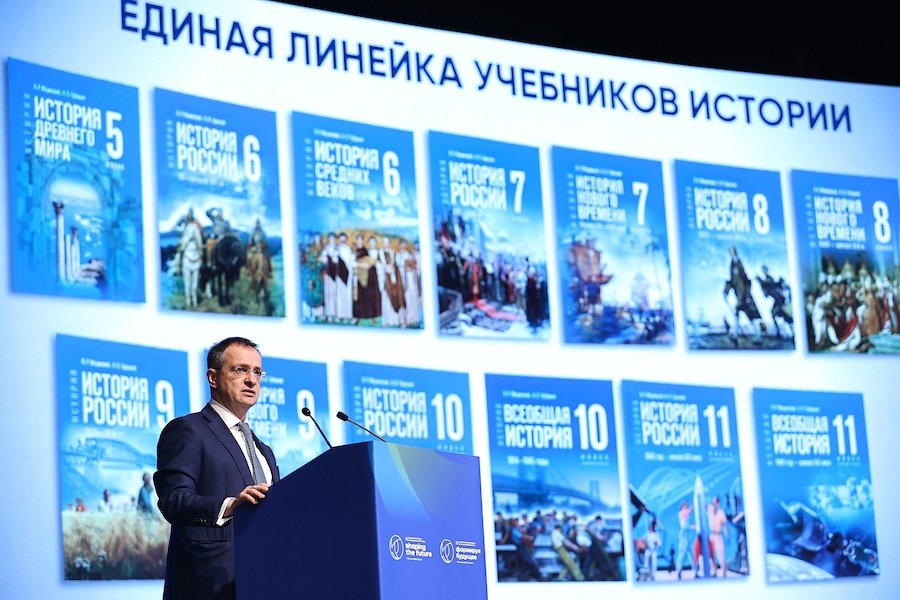
Photo: Vladimir Medinsky and two co-authors on every cover. Credit: Edu.gov.ru, CC BY 4.0, https://commons.wikimedia.org/w/index.php?curid=179570156
The interview with Executive Secretary for State History Textbooks Vladislav Kononov published by Kommersant in March 2026 presents an opportunity to examine not only institutional changes in the field of historical education, but also the ideological basis of contemporary historical politics.
The Centralization of Historical Knowledge
The modern model of historical education in schools throughout Russia demonstrates a tendency toward increasing state involvement in determining the content of textbooks.
The state representative responsible for censoring new textbooks is Vladislav Kononov, a research officer in the Administration of the President of the Russian Federation. According to him, the state acts as the arbiter in matters concerning the interpretation of historical events. The state seeks to solidify a specific version of the past.
The shaping of collective memory is an important instrument in the formation of national identity. In post-Soviet countries, including Russia, this trend is often linked to attempts to reframe historical heritage and reinforce ideological dictates.
From Educational Pluralism to a Unified Template
It turns out that Kononov—a former teacher from Smolensk—is the man behind all the new history textbooks for general education schools.
Formally, of course, the textbooks on world history bear the names of presidential aide Vladimir Medinsky and the Scientific Director of the Institute of World History of the Russian Academy of Sciences, academician Alexander Chubaryan, while the textbooks on Russian history are credited to the rector of the Moscow State Institute of International Relations, academician Anatoly Torkunov, and the aforementioned Medinsky. As of 2025, Medinsky is officially Russia’s “head writer,” having assumed leadership of the unified writers’ union.
However, it is Kononov and his small team of four who review the final versions of all the textbooks.
The previous school textbook framework included a few alternative perspectives, which offered a limited, but not insignificant, level of academic diversity. This model has been replaced by a single state-mandated line.
From the viewpoint of educational theory, this unification can be viewed as a tool for enhancing the manageability of the system (OECD, 2020, Education Policy Outlook). However, researchers emphasize that excessive standardization may lead to a decline in critical thinking and the restriction of academic discourse (Pingel, F. (2010). UNESCO Guidebook on Textbook Research and Textbook Revision).
Word Choice and the Interpretation of History
In the interview, particular attention is paid to the idea of presenting a “positive” historical narrative. This approach entails the avoidance of negative phrasing when describing complex events.
Naturally, the seizure of Western Ukraine, Western Belarus, and the Baltic states, as well as the Finnish War, are described as “incorporation”; the words “aggression” and “occupation” appear nowhere in this context. Such terms are simply not compatible with the idea of good and peaceful neighbors.
Of course, word choice (for example, “incorporation” versus “occupation”) directly influences the public perception of the past. Moreover, it shapes cognitive models in students.
For instance, in discussing the deportations, the Chechens, Ingush, Karachays, Kalmyks, Balkars, and Crimean Tatars were lumped together with “Vlasovites, Banderites, and other collaborators.” The deportations themselves were justified by citing “instances of collaboration with the occupiers.”
The deportation of the Volga Germans to Siberia and to the barren expanses of the steppes goes entirely unmentioned.
But the inquisitive journalist is given an explanation: to ensure that our merciful people would not take the law into their own hands or exact retribution against the Germans—and to avoid provoking outbursts of popular wrath—the Germans were transported to a new place of residence free of charge, at the state’s expense. And they were even permitted to take their personal documents with them.
Chechen leader Ramzan Kadyrov was highly displeased by these variations on the theme of Chechen history. As a result, the entire print run was sent to the shredder.
The textbook was revised and rewritten. Minister of Education Sergei Kravtsov—who will be remembered in the history of Russian education for the elimination of hundreds of textbooks across various disciplines in the name of a so-called singular state line—traveled to Chechnya with the revised textbooks in hand. There, before federal television cameras, he read out the corrected wording to the republic’s leadership. He was forgiven…this time.
The Cover Story
A textbook begins with its cover. The cover of the 9th-grade world history textbook features Vasily Vereshchagin’s painting The Suppression of the Indian Mutiny by the British (1884), which depicts Indians bound by British officers to the muzzles of cannons. Execution by the
“devil’s wind” was a historically employed method of reprisal in which the victim’s body was torn apart by the blast.
Above the Vereshchagin painting are the British Parliament and Big Ben.
“Here it is—the British ‘White Man’s Burden’—in contrast to our aspiration to live in peace with our neighbors,” says Kononov, explaining why this subject matter was portrayed on the cover.
It is also essential to mention the most significant innovation. For the first time since 1956, Stalin’s biography has been included in a school textbook. After all, Kononov explains, he was never convicted—so how could he possibly be left out? Mikhail Gorbachev is a different story: He inherited an entire country, Kononov fumes, yet what did he leave behind?
Textbooks and Money
The financial aspect of textbook publishing, including print runs and the royalty system, naturally sparks public curiosity. The mass production of educational literature renders this sector an integral part of the national economy.
Globally, the textbook market is often linked to government contracts and major publishing houses. As the World Bank notes, centralizing purchases of educational materials can enhance access to education but simultaneously creates risks of monopolization (World Bank (2018). World Development Report: Learning to Realize Education’s Promise.)
Previously, Russian teachers typically chose from three distinct textbook series and worked through them year after year, from the 5th grade through the 11th. In the process, they accumulated pedagogical expertise and media resources, as well as formulating responses to those questions frequently asked by students. The introduction of new textbooks, however, has rendered this professional and methodological experience obsolete, as there is now a single, unified textbook series.
Moreover, authors get paid for textbooks—and that money is not simply split neatly between the authors. Kononov explains:
“As an example, let’s take the textbook History of the Ancient World—if I’m not mistaken, its publisher’s list price, including delivery, is 250 rubles. The print run for the textbook is approximately 1.5 million copies, which works out to a total value of 375 million rubles nationwide. One percent of that sum is 3.75 million rubles—and there you have the royalty amount.”
But only one percent in royalties is simply unheard of—ten is the bare minimum.
At the same time, textbooks get damaged, and so every year, new copies must be printed and new royalties paid.
These royalties, too, are not split evenly among three parties. Consequently, they retained just one line—the state-run one—and entrusted it, without any tender process, to a single publishing house: Prosveshcheniye (“Englightenment”).
The Issue of Authorship
The interview raises the issue of collective authorship of textbooks. Apart from the trio of state-appointed historians, not a single other name is mentioned.
Kononov suggests that they might eventually be credited—but later, not now. For the time being, the textbook proudly flouts authorship rights and copyright law. The picture of Vladimir Medinsky, along with his two co-authors, on the cover is deemed sufficient. A 92-year-old academician of the Russian Academy of Sciences signing his own name to texts written by his subordinates—could there be a more shameful tableau of academic “creativity?”
International standards of publication ethics emphasize the need to clearly indicate the contribution of each author (COPE (2019). Guidelines on Good Publication Practice).
Principles and Inconsistencies
Vladimir Medinsky’s article “7 Theses: How to Study History in School” was published in the journal Dilettante on November 24, 2020. (The text is on the website of the Russian Historical Society.) The textbooks are structured according to these principles.
For example, while proclaiming the “unacceptability of distorting history,” the textbook explains in detail why claims regarding the “Soviet occupation of Europe” are considered incorrect. To wit, there was no occupation; this is a typical distortion of history.
Another distinct problem is the inconsistencies between the new textbooks by Medinsky and Chubaryan and the current examination system—specifically, the questions on the Unified State Exam (USE). Successful reforms require a comprehensive approach that entails aligning curricula, teaching methodologies, and assessment tools. Adjusting the exam questions will take time; consequently, at least one generation of graduates will be unable to use these textbooks to prepare for the USE.
* * *
An analysis of the interview leads to the conclusion that the role of the state in shaping historical knowledge within Russia’s primary and secondary school education system has increased significantly.
The transition to a unified line of textbooks has been accompanied by the centralization of the interpretation of the past, a shift in the economic model, and direct copyright infringement.
There has been an evident expansion of terminology and vocabulary that serves to justify the atrocities of the Stalin era. The inclusion of a fawningly written biography of Stalin reflects the trend toward the rehabilitation of the tyrant’s image that is currently being imposed upon society.
A key issue remains the balance between state educational policy and academic freedom. In the long term, this will be the determining factor in the nature of the historical consciousness of future generations.
A humble research officer, keeping a watchful eye on historians writing texts at the behest of their superiors—this scene once again calls to mind Hannah Arendt’s words on the banality of evil.



0 Comments