
Russia is once again implementing a unified federal reading curriculum—one for all.
Boris Lanin
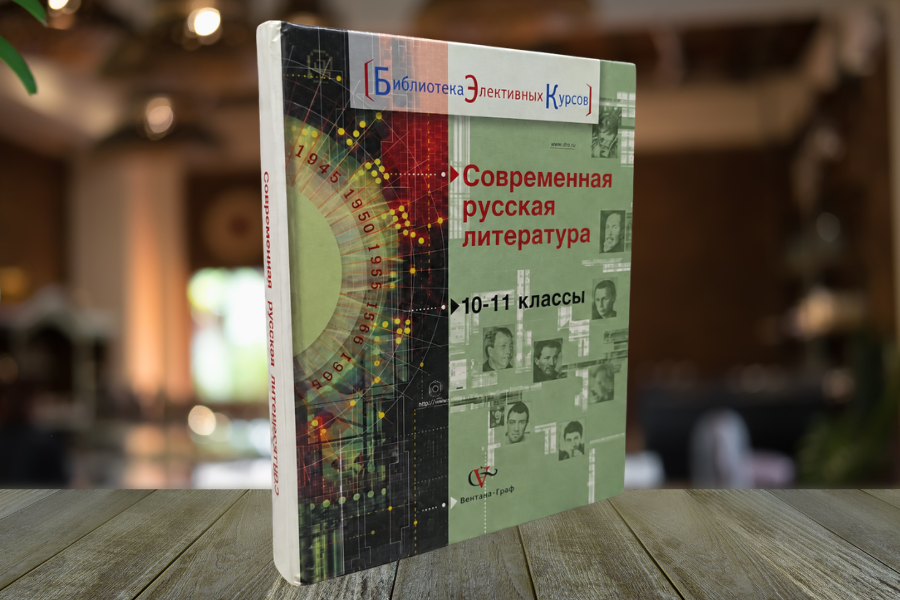
Photo: The textbook “Modern Russian Literature. Grades 10-11” is being pulled from school libraries and destroyed, and there are currently no new textbooks on contemporary Russian literature to replace it.
The “essential reading list,” or in other words, the national literary canon, is being discussed at every level of Russian society, from parents and local newspaper journalists, bloggers, and rural teachers to President Putin himself. The commission tasked with developing a national structure for philological education was headed by the Chairman of the State Duma—and now the nation’s chief intelligence official—S. E. Naryshkin.
The Canon as a State Issue
The issue of developing a national literary canon is perceived in contemporary Russian society as a matter of paramount national, cultural, and scholarly importance. It is closely linked to the concept of national identity, as well as to the preservation and development of cultural traditions.
This task is considered to have fundamental scientific significance. The canon helps:
- create a basis for further research in the field of literature teaching methodology
- develop new national standards for literary education and curriculums for general education schools and universities
- create literature textbooks based on the canon
How the Literary Canon is Interpreted
Every country has its own interpretation of the literary canon.
In Sweden, at the beginning of the school year, the teacher hands out lists on sheets of paper: 10 works that they suggest studying over the course of the year. Students edit these lists, sometimes crossing off, sometimes adding. A “soft” ranking is then compiled. The works that land in the top ten of this ranking set the agenda for the year. While the textbook on literary theory remains unchanged, the reading list of literature itself is created through this kind of ultra-democratic voting process.
In the US, each state has its own rules. There is no national literary canon. When students arrive at universities from different states, they learn about many books from one another.
The Russian literary space is constructed differently. There is no way to attain the status of a “classic” other than through the school curriculum. Only those writers who are studied in school become classics. They subsequently enter the national literary canon, becoming “required” reading—authors whom it would be “shameful” not to know.
In the novel Changing Places by English author David Lodge, British and American professors play a game that might seem strange to a Russian reader: what works from the literary canon haven’t you read? The winner is an American professor of literature who has never read Hamlet.
For Russia and Russian readers, this game would be out of the question—it is shameful and speaks to the incompetence of the professors who are playing it. Anyone who has finished school has read Oblomov and Fathers and Sons—and, nowadays, The Master and Margarita as well.
How to Get on the List
On what is the literature curriculum based?
It would never occur to anyone to discard works like Eugene Onegin, A Hero of Our Time, or Dead Souls. These essential texts form the backbone of national identity; they are the foundation upon which the national cultural code is built. A curriculum cannot exist without them.
However, even 40 years ago it was impossible to imagine a school curriculum without the novel Mother by Maxim Gorky and the poem “Vladimir Ilyich Lenin” by Vladimir Mayakovsky. Who now remembers these works, except literary scholars?
It turns out that the modern literary canon is built from works that were once recognized as classics, i.e., exemplary. It is impossible to “designate” a work as canonical; there must be national recognition of these works as classics.
A characteristic feature of these classics is that they also have mass appeal. What makes them accessible to a mass audience is not merely the number of people who have read them or the number of copies printed and sold, but also the interest shown by related art forms—theater, and especially film and television.
Books that serve as the basis for media narratives have the greatest chance of becoming canonical within the contemporary reading landscape.
“Foreign Agent Authors are Struck from the Canon!”
However, the situation changed drastically when writers began to be included on the lists of “foreign agents” (Ulitskaya and 70 other writers) and “extremists and terrorists” (Akunin, Bykov, Polozkova—five in total).
Alexander Arkhangelsky authored his own series of textbooks for grades 5–10; naturally, his textbooks are now banned.
The textbook Contemporary Russian Literature: Grades 10–11 includes, among many others, Arkady Babchenko, Lyudmila Ulitskaya, Dmitry Bykov, Mikhail Veller, Dmitry Glukhovsky, and Boris Akunin. Of course, this textbook has since been removed from school libraries and destroyed, and there are currently no new textbooks on contemporary Russian literature to replace it.
Archaization of the Canon
The current 2026 Unified State Exam (EGE) syllabus for Literature—the FIPI EGE 2026 Codifier, which includes a list of literary works and poems—plays a major role in shaping the canon.
The structure of the syllabus remains unchanged from 2025. This is not a “list of books to be read in their entirety,” but rather a selection of works that students might be tested on.
For many authors, it is sufficient to be familiar with their key works or to have a general grasp of their poems and themes. Some texts are listed as “selected chapters” or “poems.”
For the 2026 Unified State Exam (EGE), you need to know:
- Russian literature from “The Tale of Igor’s Campaign” to Bulgakov and Sholokhov
- key novels (Tolstoy, Dostoevsky, Pushkin)
- dramas (Griboedov, Ostrovsky, Chekhov, Gorky)
- Nineteenth- and twentieth-century poetry
As you can see, the literary canon is acquiring archaic features. It was like this in Soviet times (with the exception of Bulgakov).
The entire curriculum was overhauled in line with the 2021 Federal State Educational Standards (FSES) and the federal programs for 2023–2025. During this process, some literary works were added or given greater prominence, others were removed or replaced, and the focus of the remaining texts was significantly shifted—with a new emphasis on patriotic literature.
In 2022, they introduced the New Federal State Education Standard (FSES).
In 2023, the unified federal educational programs (FEP) appeared.
In 2024, updates were made (Order No. 171, etc.).
What Changed in the Literature Lists
What stands out is the increased emphasis on the theme of patriotism and military-related issues:
- Valentin Kataev, Son of the Regiment; Konstantin Simonov, “Son of an Artilleryman”; Mikhail Sholokhov, “Fate of a Man”; Aleksey Tolstoy, “Russian Character”
“Special” works by contemporary authors have also been included (aside from the classics)
- Zakhar Prilepin, Vladimir Medinsky, Anna Dolgareva and others.
Removed or reduced:
- a number of contemporary “unpatriotic” authors
- a portion of foreign fantasy
- bards (Okudzhava, Vysotsky—in a number of classes)
- partially excluded—Korolenko, Astafyev, Abgaryan, and others
Key new components for 2022–26:
- the emergence of a unified federal curriculum—one for all
- an increased number of
- nineteenth-century classics—and since 200 years have passed, we have to comment on almost every word
- war prose
- Russian literature of the Soviet period
- less experimental and contemporary foreign literature
Thus, the literary canon has become more archaic and ideologically oriented, constraining the creative, methodological explorations of university lecturers and schoolteachers.
A Rupture in the Literary Canon
The bottom line is that education has reverted to the situation as it stood in 1991. There are now two canons of reading material: one for domestic use, and another for the international sphere.
It is impossible to imagine that the works of writers designated as “foreign agents” will be studied in Russian state universities; one cannot even quote them. On the other hand, it is highly unlikely that universities outside Russia will seriously study or teach the works of writers and poets who support the “Z” cause.
* * *
The current situation ties the hands of literary scholars, not only in Russia but also in “exile.”
Connections between scientists are being severed, and many who have left the country are explicitly forbidden from publishing their work in Russia.
All of this takes us further away from any notion of what a genuine contemporary literary canon might look like in the twenty-first century.



0 Comments