
European scholars and academic repression in the USSR
Dmitry Dubrovksy
Photo: Academic degrees or titles could be rescinded from “…individuals who committed immoral, anti-patriotic, or other acts incompatible with the status of a Soviet scientist.” Photo by Pavel Danilov on Unsplash
From the very inception of Soviet power, the Soviet authorities and the intelligentsia existed in a state of mutual distrust. Professional autonomy, pre-revolution experience, and ties abroad could all be interpreted as signs of political unreliability.
Antisemitic Coding
During the Stalin period, antisemitic coding affected the European intelligentsia in particular: political enemies were very often portrayed in a pointedly antisemitic style. After the war, previously covert antisemitism transformed into an open, state-sponsored campaign.
The murder of Solomon Mikhoels, the “Doctors’ plot,” and the campaign against “cosmopolitanism”—particularly in science and higher education—were accompanied by administrative and psychological pressure on Jewish scientists and educators, as well as restrictions on their academic careers and on the access of Jewish youth to higher education and scientific fields.
By the end of the Stalin period, the combination of political repression, antisemitic campaigns, and the significant representation of Jews among the educated urban population meant that there was persistent tension regarding the alleged political disloyalty of Soviet Jewish scientists. This theme took various forms over time, ranging from insinuations about the existence of a distinct “Jewish political opposition” in the 1920s to a campaign against “rootless cosmopolitans” in the late 1940s and early 1950s.
In Search of “Rootless Cosmopolitans”
Using the example of the Pushkin Leningrad State University philological department, researchers have demonstrated how as early as 1949, the word “cosmopolitan” within the university clearly came to mean “Jew.” It was the “cosmopolitans” who were accused of disloyalty to the USSR, and of either deliberately or unintentionally “working for the Bourgeois West.”
The campaign against “cosmopolitanism” was waged not only through direct administrative pressure, but also through academic procedures—personnel reviews, expert commissions, academic councils, peer review, and the evaluation of research schools. Suspicions regarding political disloyalty and “improper origins” were translated into the language of professional and ethical assessments of a given scientist’s work.
In 1949, M.E. Fidelman’s dissertation was labeled “apolitical and cosmopolitan” due to its excessive use of German and American literature and failure to sufficiently highlight Soviet achievements (even though the work focused on the footwear industry).
Following the publication of Abram Ioffe’s book Fundamental Concepts of Modern Physics, there appeared ideologically charged reviews that accused the author of “kowtowing to the West.” A special commission was established at the Leningrad Physicotechnical Institute, and a meeting of the Academic Council was held on March 3, 1952. Ioffe was accused of a lack of “Party spirit,” being influenced by Western science, and a “European spirit.”
Thus, ideological suspicions—compounded by “improper origins”—were formalized through peer reviews, expert committees, and, ultimately, the Academic Council.
However, academic institutes not only carried out repressions, but also resisted them. This latter dynamic was particularly evident among physicists, whose role in the Soviet atomic project afforded them a certain degree of protection.
After Stalin
After Stalin’s death, the pressure on Jewish scholars noticeably eased. However, researchers have shown that the turn away from direct repression did not represent a return to pre-war conditions, even if a number of professors who had faced repression during that time were allowed to return to work.
At the same time, researchers of Soviet science draw attention to the difference between the situation in higher education and that prevailing in scientific institutions.
- In scientific institutions, the absolute number of Jewish scholars actually doubled between Stalin’s death and the mid-1960s (even if their proportional share declined).
- In higher education institutions, the general liberalization of the post-Stalin era was fully compatible with at lower levels of administration.
At the same time, the scientific community remained an environment of limited autonomy. Many prominent dissidents and human rights activists were scientists (and particularly physicists), among them Andrei Sakharov, Yuri Orlov, and Valery Chalidze.
A new wave of antisemitism during the Brezhnev era coincided with a rare opportunity for Soviet scientists. For Jewish scientists, who faced significant discrimination not only in daily life but also in the workplace, it offered a chance to leave the USSR and continue their work in an environment where their ethnicity did not affect their professional careers.
However, the Soviet authorities, having imprudently agreed to allow Jewish emigration from the USSR as part of the “thaw policy” of the early 1970s, soon realized the scale of the issue and began placing various obstacles in the path of those wishing to leave—ranging from bans based on various forms of “secrecy” (of which there was a great deal in the USSR) to demands for “compensation” for the higher education they had received.
On the Political Loyalty of Scientists
Other mechanisms of repression directly linked to the academic sphere were also deployed against scholars—specifically, the aforementioned measures involving the loss of employment and the revocation of academic degrees. Simultaneously, restrictions on Jewish enrollment in higher education institutions intensified. In Moscow, a notorious “Jewish” problem set was used; consisting of problems that were either extremely difficult or entirely unsolvable, it was assigned specifically to Jewish applicants to ensure they would fail their entrance exams.
In the early 1970s, the wording of direct ideological directives and decisions issued by academic councils and other public bodies during the 1940s and 1950s began to appear in regulatory acts—specifically those concerning the revocation of academic degrees and titles.
For instance, the 1972 Higher Attestation Commission (HAC) regulations on the procedure for awarding academic degrees and conferring academic ranks stated: “The awarding of the academic degree of Doctor or Candidate of Sciences shall take into account the moral, political and professional character of the applicant.” In accordance with this principle, individuals could be stripped of an academic degree or rank if they had “committed immoral, anti-patriotic, or other acts incompatible with the status of a Soviet scientist.”
Under the procedure established by these regulations, academic councils, both research-oriented and university-based, could petition for the revocation of titles and degrees. In other words, political loyalty was embedded in the system for evaluating knowledge, and any perceived breach of loyalty was equated to a violation of academic ethics.
Rescinding Degrees
This practice affected more than just Jewish refuseniks. The Chronicle of Current Events (CCE) reported instances of this as early as 1973.
Alexander Bolonkin was stripped of his Candidate of Sciences degree, and his doctoral dissertation, which had already been cleared for approval, was rejected by the HAC.
Vasily Lisovoy was stripped of his Candidate of Philosophical Sciences degree.
In 1975, an attempt was made to apply the same rule to Kronid Lyubarsky: the HAC openly demanded that his research institute initiate proceedings to strip him of his degree on the grounds of “anti-patriotic activity”—a term the HAC used to refer to human rights advocacy. It is telling that, according to the Chronicle of Current Events, the head of the laboratory tried to defend Lyubarsky by citing his scientific achievements, yet the institute’s director declared that what mattered now was not his professional competence but his “public persona.”
The most famous case was that of Efim Etkind, who had his doctoral and candidate’s degrees rescinded in 1974. His case was apparently the first in which degrees and professorships were revoked at the same time.
In doing so, the rector, speaking at the Academic Council, pointed out that Etkind had been warned as early as 1968 about the impropriety of his actions:
“But Professor Etkind had no intention of changing his views—he maintained close ties with Solzhenitsyn and drafted an appeal to young Jews leaving for Israel.”
The blatantly political nature of the order was obvious: a KGB report detailing his interactions with Solzhenitsyn and Brodsky was read out at the Academic Council meeting. During the ensuing discussions, Etkind was branded a “double-dealer” who had allegedly “championed anti-socialist and anti-Soviet views on morality.”
In the speeches delivered, the link between alleged “anti-Sovietism” and Jewishness was quite apparent. At that same Academic Council meeting, philosophy lecturer A. Merzon stated that Etkind’s position was an expression of “Jewish nationalism turned inside out.” Also telling was the reference to the “Letter to Young Jews Seeking to Emigrate.” In that letter, Etkind had actually urged Jews not to leave for Israel, but to strive for equal rights within the USSR. Nevertheless, the letter was used as evidence of Etkind’s “Jewish nationalism” and “Zionism.”
Similarly, during a discussion organized at a meeting of the Leningrad branch of the Writers’ Union, Mikhail Dudin asserted that “Zionism oozes” from Etkind’s texts and that such nationalism is “but a short step away from fascism.”
After being stripped of his academic degrees and titles, Etkind was effectively forced out of the country. He himself put it this way:
“They are Russian; I, however, am a Jew, and I ought to go to Israel.”
“Immoral, Anti-Patriotic, or Other Acts”
In 1975, the Council of Ministers of the USSR enshrined this rule in a special decree: academic degrees could be revoked for plagiarism and scientific misconduct, as well as for “immoral, unpatriotic, or other acts incompatible with the status of a Soviet scientist.”
A copy of a standardized HAC resolution has been preserved in the Samizdat Archive; in it, moving abroad and applying to renounce USSR citizenship are explicitly characterized as unpatriotic behavior.
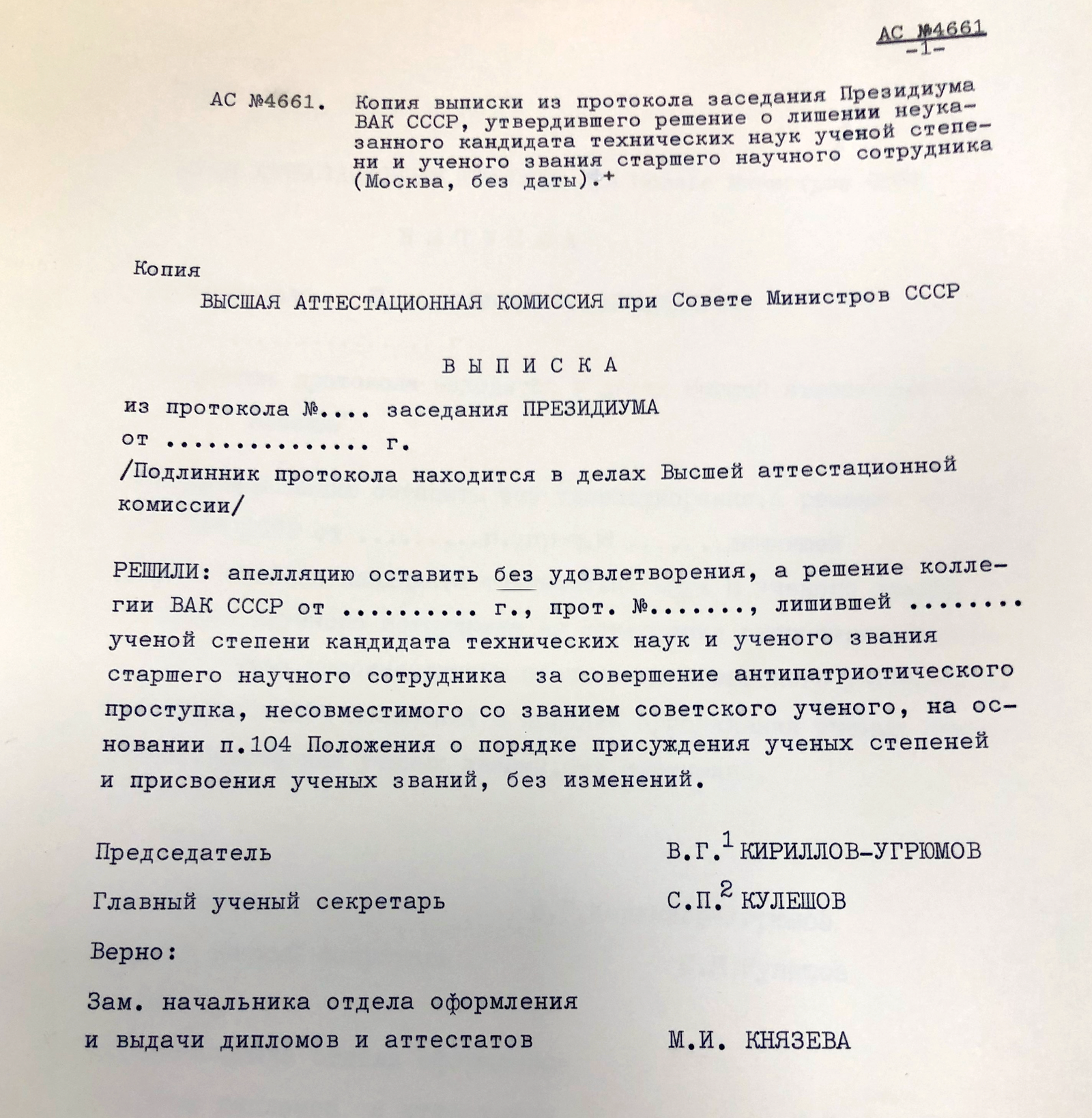
SUMMARY OF DOCUMENT: A standard HAC document rejecting the appeal of a previous decision to rescind the academic degrees and titles of a senior researcher. Names, dates, and case numbers are left blank (indicated here with a dotted line).
Academic institutions typically dismissed from their positions Jews who had applied to emigrate. However, the revocation of academic degrees did not always follow. This practice became systematic between 1980 and 1982; a U.S. report identifies approximately 65 scientists who had either already been stripped of their degrees or were being subjected to the rescission process. While the exact number of those affected requires further verification, each such decision spelled effective academic death for the Soviet scientist, often years before they were granted permission to leave.
One illustrative case is that of Vladimir Melamed—the minutes of whose hearing have also been preserved in the Samizdat Archive. On January 20, 1982, the specialized council of the Moscow State University Faculty of Geology reviewed his application to emigrate, characterizing it as an “anti-patriotic act.” Professor E.V. Karus argued that a degree holder must possess “professional competence, morality, and patriotism,” and that Melamed now lacked the latter quality. Sixteen of the seventeen council members voted to strip him of his degrees.
Thus, the scientific procedure for evaluating scholarly achievements, specifically academic degrees and ranks, as well as adherence to academic ethics, was incorporated into the system of political repression. In the decisions of Academic Councils, applying for permission to leave the USSR was frequently equated with “anti-patriotic behavior.”
Texts from the Chronicle of Current Events contain an appeal from Jewish refuseniks stating:
“…the mere act of applying for permission to leave the country typically results in dismissal from one’s job or a transfer to low-paid employment…Students are expelled from their institutes and subsequently conscripted into the army, only to face a refusal of their exit application later on the grounds that their departure would be ‘detrimental to the interests of the state.’ Scientists are stripped of their academic degrees and titles, thereby losing the opportunity to work in their fields. University lecturers and prominent engineers end up working as stokers, bathhouse attendants, manual laborers, and the like.”
In The History of Dissent in the USSR, Lyudmila Alexeyeva writes of more than 500 Candidates of Sciences and 40 Doctors of Sciences who had found themselves in precisely this situation by the early 1980s.
As a result of the systematic exclusion of Jews from academia and the denial of educational opportunities based on antisemitic practices, there emerged in the country a Jewish academia that ran parallel to the official one, ranging from the legendary Jewish People’s University to an extensive network of home-based seminars. Those awaiting permission to emigrate taught students who were often barred from entering higher education institutions in a country that was officially “tolerant.”
Toward the end of the Soviet era, some decisions to revoke academic degrees and titles were reconsidered. A procedure for the reinstatement of academic degrees and titles was established in 1990. That same year, Larisa Bogoraz had her degree restored, and in 1994, Efim Etkind had his degrees and titles reinstated.
The wording regarding “anti-patriotic activity” disappeared from the HAC regulations in 1989.
* * *
In a similar way, academic freedom in Russia is currently under attack. Criticism of the Putin regime or participation by scientists or students in an opposition rally is declared a “violation of academic ethics.”
The authoritarian regime follows the same path. It is possible that the policy of rescinding academic degrees for “anti-state behavior” may experience a rebirth.
To a significant extent, the experience of those within Russian academia who have been designated “foreign agents” mirrors that of Soviet refusenik scientists.
Materials used from OSA Blinken Archive



0 Comments