
How Russian scientists are working with Asian markets to trade scientific papers.
Andrey Rostovtsev
Photo: Russia is being flooded by papers published through purchased co-authorship. Photo by Isa Az on Unsplash
The creation of large language models has fundamentally improved the quality of automatic translation of scientific texts and provided mass access to the corresponding tools throughout the civilized world. These advances coincided with the onset of Russia’s full-scale military aggression in Ukraine and led to the emergence of new forms of plagiarism and falsification in Russian scientific papers.
Below, based on published materials from the online publication T-invariant, we present a brief overview of current trends in violations of publication ethics that have emerged and become widespread in Russia in recent years.
Academic Looting
A phenomenon that can be described as academic looting has emerged and become widespread: Russian scholars are translating existing Ukrainian-language texts into Russian and presenting the results as their own.
To assess the dynamics of this phenomenon, a random selection of articles by Russian authors published in Russian-language scientific journals up to 2023 was examined.
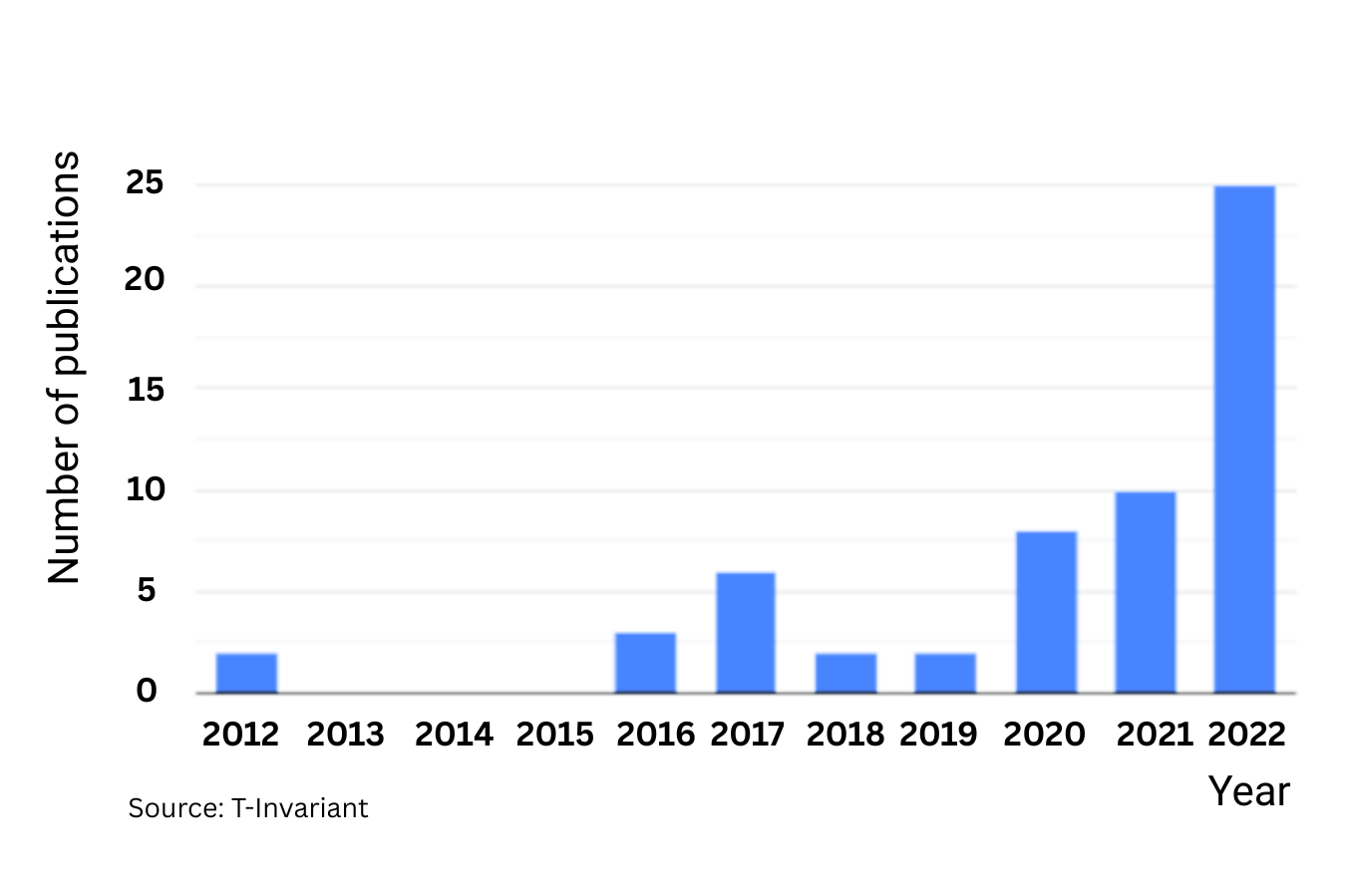
Fig 1. The number of articles in Russian-language journals that represent plagiarism in translation of existing Ukrainian-language texts, by year of publication.
Since the start of the full-scale Russian invasion of Ukraine, the number of texts that are plagiarized Russian-language translations of Ukrainian academic texts has at least doubled.
This phenomenon is partly explained by the proximity of the two languages and the ease of translation. It is also due to the fact that any claims or accusations of plagiarism encounter formal difficulties. After all, access to Ukrainian websites and the materials posted on them is restricted in Russia, primarily due to Roskomnadzor blocking them as part of cyber-censorship and information warfare.
Over the past couple of years, articles by Russian scientists plagiarized from existing Ukrainian-language texts, translated into Russian, and published in Russian-language scientific journals have appeared much more frequently than before. Moreover, the purported “authors” of these plagiarized works are not simply undergraduates with poor grades, but—more often than not—professors and doctors of science: individuals who are responsible for scientific and educational policy, and serve as true mentors to young people.
Thus, an article on philosophy published in the Russian scientific journal Humanities and Social Sciences (issue no. 4 for 2025) is a plagiarized translation of a Ukrainian dissertation defended in Kyiv in 2021. Both named authors are doctors of philosophy and professors at Don State Technical University. Furthermore, the first author is the chair of the dissertation defense council, while the second is responsible for research work.
A natural question arises: Who went to the trouble of producing such a publication for these esteemed doctors of science? It is impossible to imagine that they would band together to translate other people’s works from Ukrainian into Russian and then, without batting an eye, submit the resulting manuscript to the editors of a scientific journal.
Perhaps the following analysis of similar cases will help to answer this question.
Paper Mills
In the article “The Ease of Translation: How Plagiarizing from Ukrainian Has Gained Popularity in Russian Academic Circles Since the Beginning of the War,” the online publication T-invariant reports on a word-for-word Russian translation of part of a dissertation defended a year earlier in Kyiv in Ukrainian that was then published in the journal Izvestia of the Kabardino-Balkarian Scientific Center of the Russian Academy of Sciences in 2024.
Notably, the author of this article is Sergey Dokholyan, a Doctor of Economics, professor, Chief Researcher and Head of the Laboratory for Issues of Standards and Quality of Life at the Institute of Socio-Economic Studies of Population of the Federal Research Center of the Russian Academy of Sciences, and Honored Scientist of the Republic of Dagestan.
How is this possible? A respected scientist, a member of the editorial board of the very same journal, Izvestia (and the editorial boards of eight other scientific journals), as well as a permanent member of the Russian Academy of Sciences’ expert council—are we really expected to believe that he downloaded someone else’s work in Ukrainian from the Internet, translated it into Russian, and passed it off as his own?
It was then discovered that the same Ukrainian dissertation had also been a source of inspiration for co-authors from Chechen and Dagestani universities. However, a completely different portion of the dissertation’s text was translated into Russian and published.
That is, the authors, their affiliations, journals, and the excerpts used were different, but the source of the scientific work was the same.
It is logical to assume that a third party was involved in preparing the texts of future scientific publications and offering them to interested authors. This is precisely the principle on which paper mills—factories for producing fake publications in scientific journals—are organized worldwide. Apparently, Dokholyan and the scientists from Makhachkala and Grozny simultaneously, without collusion, utilized the services of one of these factories.
Turn to the East
Here we draw an important conclusion. Today, Russian authors are active customers of markets that trade in co-authorships and publications in scientific journals.
These markets existed before the start of the war. Take, for example, the Moscow paper mill International Publisher and its post-Soviet counterparts in Kyiv, Riga, and other cities.
But in terms of scale and audience reach, they can hardly compare to similar Asian markets in China, Iran, and the Middle East. Moreover, starting in 2022, Russian scientists in Europe have been partially subject to sanctions and have become victims of political “cancel culture.” These circumstances have forced them to gradually shift the focus of their scientific collaboration toward the east.
Therefore, at first glance, it is not surprising that, since 2022, European authors have increasingly not been listed as co-authors of Russian scientists.
In their place are the names of Asian researchers. International collaboration with scientists from Asian countries would be nothing but welcome, were it not for one unfortunate caveat: along with publications that are the result of conscientious scientific research, Russia has been flooded by papers published via purchased co-authorship through Asian paper mills.
The most striking example of such mediation became the subject of T-invariant’s recent article “Russian-Saudi Anomaly: How UrFU, RUDN University, and Sechenov University Built a Scientific Caliphate on Asian Authorship Exchanges.” Let’s examine this case of Russian-Saudi publishing collaboration in more detail.
The Saudi Anomaly
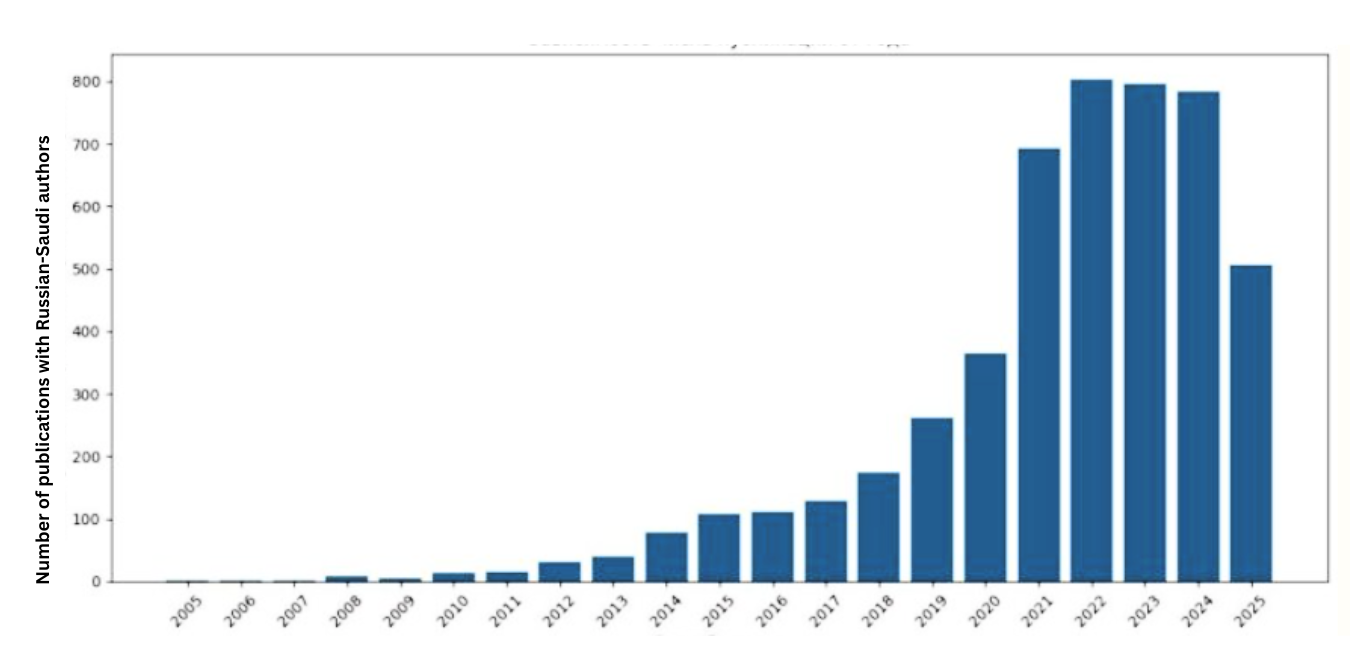
Fig. 2. The number of Russian-Saudi articles in international scientific journals by year of publication.
Observe the change in the number of Russian-Saudi articles in international scientific journals by publication year.
Until 2008, scientific publications co-authored with Saudi Arabian scientists were extremely rare—on average, one paper per year. Where they existed, the affiliations of Russian authors were likely to indicate the presence of genuine international collaboration in physics or medicine.
Since 2008, the number of joint projects with Saudi Arabia has been growing annually, with Russian universities joining the fray. By 2015, the number of joint publications had increased 80-fold.
Let us recall the decree made by Putin in May 2012, in which he stated that by 2015, it was necessary to “ensure an increase in the share of publications by Russian researchers in the total number of publications in global scientific journals indexed in the Web of Science database to 2.44%.”
It is interesting to note that during this period, there were practically no foreign names among the co-authors from Russian organizations.
This period also witnessed a steady increase in the number of joint publications. By the start of the full-scale military invasion of Ukraine in 2022, the number had reached a record high—approximately 800 articles per year—and remains at this level today.
At the same time, the overall picture has changed fundamentally in recent years: now, there are practically no Russian names listed among the co-authors of jointly published articles from Russian organizations. They have been almost entirely replaced by authors from Middle Eastern countries.
The authorship teams of scientific articles are becoming more diverse. In addition to authors from Russia and Saudi Arabia, one often sees affiliations from countries such as China, India, Egypt, Iran, and Iraq.
We are also seeing a lack of stable authorship collectives. The teams of article authors are “a mix of people with completely different affiliations, for whom this is likely the only time that they are listed together [as co-authors], which becomes obvious when cross-checked in Scopus.”
All this together indicates that the absolute majority (about 99%) of Russian-Saudi works are distributed through Asian exchanges for trading scientific publications and authorship thereof.
Interestingly, while the overall number of scientific publications in international journals with Russian affiliations has significantly declined during the years of the full-scale war in Ukraine, the number of Russian-Saudi collaborations has reached a historic high. And this is only a small, if illustrative, example of Russian-Saudi collaboration.
* * *
Advanced technology for artificially boosting publication activity at Russian universities is a relatively recent development. Universities hire Indians, Iranians, Saudis, Egyptians, and others, often on a part-time basis, to work with Asian research exchanges. These authors are more easily integrated into the Asian academic fraud market.
The results of this are described in detail and with numerous examples in T-invariant’s Plagiarism Navigator Project.

0 Comments