
Debates on Neutrality and the Problem of Academic Freedom
Dmitry Dubrovsky
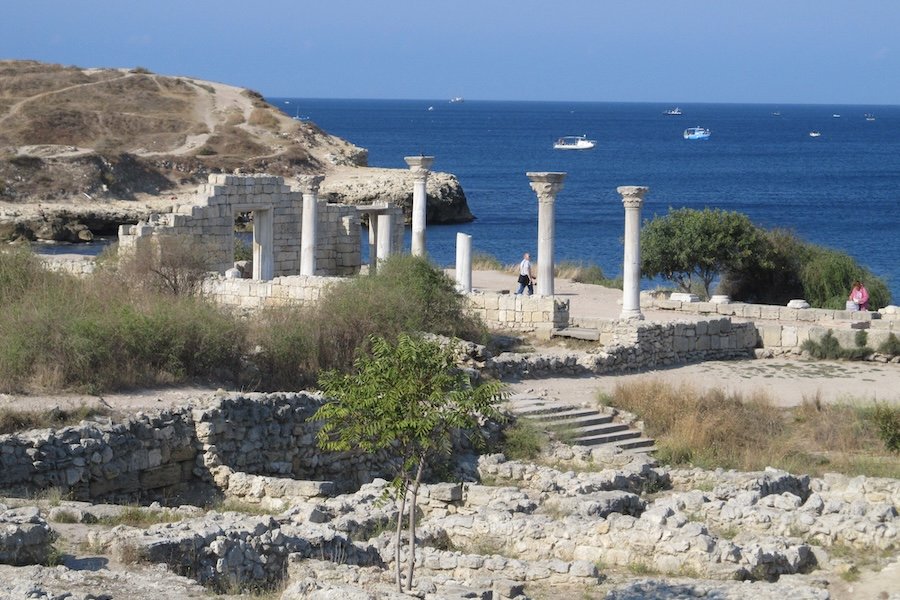
Photo: The ruins of Chersonesos, which has now become part of the larger effort to legitimize Russia’s annexation of Crimea. Photo by Ivan Tarasenko – Own work, CC BY-SA 3.0, https://commons.wikimedia.org/w/index.php?curid=21676276
Science Outside of Politics?
Debates about whether archeology is a “neutral” science that exists outside the realm of politics are not new. We touched on this topic before the war, when there were already serious objections to Russian archaeological excavations in Crimea. International and Ukrainian archaeologists alike considered these to be in violation of both international law and academic ethics.
Recently, the conversation has grown heated. At Ukraine’s request, Alexander Butyagin—Head of the Northern Black Sea Region Archaeology Sector within the Hermitage Museum’s Department of the Ancient World—was detained in Poland. He is accused of “illegal excavations” and “the destruction of cultural monuments” in occupied Crimea.
This detention and the subsequent decision to extradite the scholar to Ukraine has reignited debates regarding the extent to which the practice of archaeology—particularly of the ancient world—constitutes a “pure science” serving the entirety of global culture, and thus ought to remain independent of, and shielded from, “politics.”
Proponents of this position emphasize that otherwise, the academic right to conduct research—of which archaeological inquiry is an integral part—is violated.
Similar disputes primarily concern the conduct of occupying powers—both in the past and in the present. Historical examples include Nazi Germany and its excavations in Greece and the occupied parts of the USSR; present-day examples include Israel’s excavations in the occupied parts of Palestine.
Nazi Germany’s Archaeological Research in the Occupied Territories
Nazi Germany openly conducted archaeological research in occupied territories, primarily Greece and the occupied parts of the USSR.
After the Second World War, archaeological excavations in and of themselves were not listed as reasons for the sentences handed down to Nazi criminals. Nevertheless, these excavations undoubtedly had an impact on academic careers.
August Schörgendorfer: “Rescue Excavations” on Occupied Crete
The story of August Schörgendorfer—an Austrian archaeologist who, in 1941–42, organized operations on the Nazi-occupied Greek island of Crete—is a telling example. He designated these excavations “rescue operations,” undertaken with the aim of saving an archaeological site. To secure the opportunity to do so, he became an employee of the Nazi Kunstschutz institute—the very same organization responsible for the seizure of cultural assets, including archaeological artifacts.
Following the defeat of the Nazis, he faced scrutiny regarding his Nazi past. His habilitation (a German teaching and research qualification) at the University of Graz was rejected. A significant portion of the archaeological material he had acquired was returned to Greece.
The archaeologist’s academic career came to an end, and he spent the remainder of his life working as a tax consultant. He died in 1976.
Hans Reinerth: Rosenberg’s Favorite Archaeologist
Another example is the story of Hans Reinerth, the favorite archaeologist of the chief Nazi ideologue, Alfred Rosenberg. In addition to actively developing the field of “ancient Germanic archaeology” under Rosenberg’s direction, Reinerth also conducted excavations in occupied Greece. In 1941, he excavated a Neolithic site in Thessaloniki. The artifacts found were subsequently returned to Greece.
Following the defeat of the Third Reich, fellow archaeologists identified Reinerth as the “single culprit” who collaborated with the Nazi regime. Yet according to historical records, at least two hundred German archaeologists collaborated with the Nazi regime in one way or another—primarily in the search for “Germanic ancestors” and looting the cultural heritage of other nations.
Unlike Schörgendorfer, Reinerth was not entirely barred from the academic world. Although he lost all his academic credentials and even faced public scrutiny of his actions by German scholars in 1949, he subsequently became the director of an archaeological museum in a small town on Lake Constance.
Herbert Jankuhn: SS Officer and Professor
There were also instances where archaeologists faced no repercussions whatsoever in their academic careers, despite not only collaborating with the Nazis but even serving in the SS. One example is Herbert Jankuhn, who had been before the war an associate professor at the University of Kiel. During the war, he served as an intelligence officer in an SS division. During that time, he was enlisted to assess the condition of archaeological sites. He evaluated the general prospects of excavations in occupied Ukraine and, in the summer of 1942, conducted excavations at Mangup, a Gothic-era fortress. In early 1943, Jankuhn participated in transporting the remnants of Paleolithic collections from occupied Kharkiv to Berlin.
Following Germany’s capitulation, he found himself among those German scientists retained by academia, despite his active collaboration with the Nazis and his service in the SS. Under normal circumstances, in accordance with the rulings of the Nuremberg Trials, this would have constituted grounds for criminal prosecution.
As early as 1949, Jankuhn delivered guest lectures in Kiel, and after 1956, he obtained a position at the University of Göttingen, where he served as Head of Department until 1973.
International Rights: Lessons from the Past
International law has taken these tragic lessons from the past into account.
The 1954 Hague Convention for the Protection of Cultural Property in the Event of Armed Conflict expressly prohibits the requisition of cultural property situated within the boundaries of another territory (Art. 4) and further stipulates that the country controlling the territory bears responsibility for the preservation and protection of any artifacts of cultural value.
The Second Protocol to this Convention, adopted in 1999, explicitly states that archaeological excavations are prohibited, except where necessary for their protection or preservation, and provided that they are carried out in cooperation with national authorities.
Finally, the Council of Europe’s 2017 Nicosia Convention demands the imposition of criminal liability for looting cultural property.
Thus, although international law specifically distinguishes between the responsibility of states for excavations in occupied territories and the responsibility of individuals—archaeologists—for conducting them, this issue continues to spark serious disputes and disagreements, both regarding the history of archaeology and archaeological excavations in the present.
Modern Cases: Israel, Cyprus, and Greece
With regard to the past, there are serious questions concerning the provenance of archaeological collections resulting from violent seizure and excavations by colonizers.
Today, the most heated disputes concern archaeological excavations in Jerusalem and the Occupied Territories, as well as in Northern Cyprus and Greece. In her recently published monograph, Marie-Louise Windbladh demonstrates how, in the contemporary world, archaeology can no longer claim to be a “pure” and “neutral” science. The examples of excavations in these regions lead her to conclude that archaeology is inextricably involved in processes of legitimizing territorial seizures, bolstering nationalism, validating occupation, and appropriating cultural heritage.
Emek Shaveh and the Monitoring of the Use of Archaeology
Emek Shaveh, an organization established specifically for this purpose in Israel, documents instances of the overtly nationalistic instrumentalization of archaeology—including using archaeology to facilitate the seizure of Palestinian lands. The organization’s monitoring reveals how selective research has become routine, directly disregarding the multi-ethnic and multi-religious character of the territory and thereby serving as a tool to legitimize the occupation itself.
Researchers within Israel note that from the very beginning, this archaeological activity has had an openly political character. The sharp increase in the volume of excavations following the occupation of these lands was accompanied by the integration of their findings into a broader national narrative regarding the past—one that effectively excludes Palestinians and, more generally, the Islamic cultural heritage. At the same time, the authors acknowledge that undoubted strides have indeed been made in research, and significant archaeological discoveries have been brought to light—a fact that renders the question of the political dimension of this activity all the more pertinent within the context of a protracted conflict. Specifically, questions arise regarding the accountability of individual archaeologists for conducting excavations in occupied territories, as well as the rightful ownership of specific cultural artifacts.
Decision of the World Archaeology Organization
A recent decision by the World Archaeological Congress serves to illustrate the application of the principle of academic responsibility regarding the conduct of such excavations: the organization expelled an unnamed archaeologist working at Ariel University in Israel from its ranks.
In its statement, the WAO declared that this decision was prompted primarily by the status of the university itself—as an educational institution established in the Occupied Palestinian Territories—and by archaeological excavations in the occupied territories, which the organization had previously urged against undertaking. The statement concludes with a call for an ethical approach to archaeological practice and an expression of solidarity with those communities whose cultural heritage and cultural rights are being openly violated amid the occupation and military conflict.
The Case of Alexander Butyagin
One could use the same guiding principles in the case of Alexander Butyagin.
The Russian Federation asserts that the scientist “did not violate international principles,” whether legal or ethical.
According to independent observers, the question is whether excavations in occupied territories constitute “merely” unauthorized excavations—or, as Ukraine insists, the “destruction of an archaeological site,” which constitutes a gross violation of the law.
Many Russian commentators claim that “science is above politics,” thereby dismissing ethical concerns as irrelevant.
Ukrainian archaeologists, conversely, consider it important to offer moral assessments now—rather than decades later, as was the case with Nazi-era excavations.
Finally, one commentator makes an important observation: outside of his archaeological excavations, Butyagin is also actively involved in the construction of the “New Chersonesus” ideological complex—a project that forms part of a broader political strategy aimed at legitimizing the annexation. A recent publication on the website of the European Association of Archaeologists draws specific attention to the fact that the primary activity currently taking place in Crimea is not historical in nature, but rather ideological; its main objective is not the preservation of monuments, but rather a dubious form of “historical reconstruction.”
There are two distinct issues here: the extent of legal liability and the extent of professional responsibility.
It appears that a professional assessment of his actions in Russia will certainly be postponed until the end of the Putin regime. It is difficult to imagine such an assessment taking place now, given the total lack of freedom that currently prevails within Russian academia. At the same time, it seems that the European Association of Archaeologists has already expressed its professional stance.
Legal liability, however, must be determined in court.
Archaeology as a Social Science
Strange as it may seem, archaeology is, above all, a social science, for it cannot exist in complete isolation from various conceptions of the politics of the past.
The politics of the past are precisely what have influenced—and continue to influence—which research topics and monuments are prioritized in the study of any given history. This is particularly evident in discussions regarding these policies as they apply to occupied territories.
That is exactly why discussions of whether archaeology can be “neutral” today seem detached from the actual practice of the instrumentalization of archaeology in the politics of the past—primarily for the purpose of its appropriation, which is directly linked to the legitimation of territorial seizures.
Appeals to academic ethics cannot serve as a tool to shield scholars from accountability. To claim one is merely “conducting science” amounts to a refusal to engage with one’s own political complicity in the actual practices of occupation.
As a science, archaeology must strive to combine the principles of academic freedom with academic reflection and responsibility. Only in this way can instances of conflict between formal research logic and academic ethics be avoided.
Dmitry Dubrovsky holds a PhD in History and is a researcher in the social sciences department at Charles University (Prague), a research fellow at the Center for Independent Sociological Research in the USA (CISRus), a professor at the Free University (Latvia), and an associate member of the Human Rights Council of St. Petersburg.



0 Comments