

For Russian scientists, the imposition of “foreign agent” status is tantamount to being banned from work
Dmitry Dubrovsky
Photo by Aron Visuals on Unsplash
The laws on “foreign agents” and “undesirable organizations,” which were adopted over 10 years ago, are part of a package of legislative initiatives that formalized Russia’s anti-Western turn. Their primary goal was to combat the political opposition, independent civil society, and media. Even then, however, some scientific organizations fell victim to these restrictions. Scientists note that this status has had a serious impact on research, leading to the closure of some organizations and significantly limiting the capabilities of others.
Initially, only legal entities received “foreign agent” status. Since 2020, this designation has also been applied to individuals.
As part of the fight against the “Orange Threat” (a term Putin has used to describe the threat of a Russian color revolution along the lines of the 2004 Orange Revolution in Ukraine), so-called “foreign agents” were—among many other prohibitions—barred from involvement in teaching and educating minors. In December 2025, this was extended to a complete ban on teaching by individuals recognized as foreign agents.
This article summarizes the results of a study conducted in December 2025–January 2026 among Russian scholars and faculty members designated as “foreign agents.” The full text of the study will be published in the collective monograph Threatened Scholarship, Dynamics of Repression, and Modes of Resistance. Towards Academic Freedom as a Transnational Human Right (AUP, 2026).
As part of the study, 21 scientists identified as “foreign agents” were interviewed. In this article, save for a few exceptions, they are anonymized by default—their names are replaced with numbers.
Restrictions, Censorship, and Repression
The common definition of academic freedom consists of:
- the right to teach
- the right to study
- the right to disseminate the results of your research
Analogous to Hannah Arendt’s “right to have rights” in the case of basic human rights, in this study we added to this the “right to be able to act as a scholar”—or, in Macfarlane’s words, the “right to academic citizenship.” “Foreign agent” status puts this right at risk.
Academic Excommunication, “Cancellation,” and “Academic Death”
Respondents—primarily those who have remained in Russia—note that the imposition of the status of “foreign agent” effectively entails excommunication from other colleagues.
”I receive no official invitations anywhere” (2), and “bureaucratic officials have stopped communicating with me” (8).
Overall, as one of the “foreign agents” noted, “communication leads to nothing” (11).
At the same time, self-censorship comes into play; the “foreign agent” scientists themselves have begun to “communicate more cautiously” (3), anticipating that the consequences of such interactions could be dangerous for their colleagues.
Those who have left Russia also note that they have largely lost contact with their former professional contacts (4). One respondent went so far as to describe this as the “disappearance of the institutional environment” (13).
Digital Repression: From Stigma to Cancellation
Repressive measures sometimes take the form of over-compliance, whereby a site or institute goes further than what is required by law:
- Instead of adding the required discriminatory “disclaimer” to a text, they simply obliterate all mentions of the name of the “foreign agent”
- Not only do the pages of such staff and faculty members disappear from institutional websites, but in a number of cases, entire scientific publications have likewise vanished.
As a result, respondents say that they have been “erased”: “I have been completely erased. There’s nothing that I’ve done…” (9).
The law specifically restricts the sale and distribution of books by “foreign agents.” In practice, a number of libraries are removing books by authors designated as foreign agents from open access and transferring them to a restricted storage regime (known as “spetskhran,” or “special storage”). Legislative amendments enacted in 2024 laid the groundwork for the Ministry of Culture to issue subordinate regulations governing “special storage” and access rules—regulations that are, in their underlying logic, reminiscent of the Soviet-era spetskhran system.
At the same time, the distribution of books in bookstores is significantly complicated both by requirements for special labeling and sales procedures akin to those imposed on adult material and by pressure tactics—particularly against independent bookstores—aimed at restricting or entirely eliminating the distribution of books by “foreign agents.”
Thus, one of the direct consequences of being designated a “foreign agent” is the threat that a scholar or educator’s output—whether online, in libraries, or in bookstores—will be compulsorily labeled as “foreign-agent material” or even erased entirely.
The Right to Teach and Learn
Judging by some of the responses, in a number of cases, university administrations were aware that faculty members were soon to be designated as “foreign agents” (19). In instances where a “foreign agent” was still employed by the university, the administration reacted immediately: “At the Higher School of Economics, they suggested I leave [voluntarily].” (9).
Respondents note that university administrations were subjected to intense pressure to prevent “foreign agents” from working, even in capacities unrelated to teaching. Employment contracts were terminated immediately, including in the middle of a semester, before university courses had been completed. One “foreign agent” was suspended and dismissed immediately (18).
Even prior to December 2025, dismissal meant that respondents could find no work in the fields of higher education and science. Respondents explain that “…all activity came to a halt” (2), since “it is impossible to teach anywhere” (1).
Even what are known in Russia as “enlightenment activities”—open, public lectures—have been effectively prohibited: “enlightenment activities have been completely shut down” (15). This, too, constitutes a professional ban for educators and public intellectuals.
The Right to Research and Disseminate Research Data
Although the law formally contains no prohibition on scientific activity by “foreign agents,” in practice—as respondents report—it is nearly impossible to maintain an affiliation with a Russian institution, whether for the purpose of employment or for publishing research.
For different categories of researchers, a professional ban operates in different ways.
A scholar working within the fields of the humanities and social sciences will find it comparatively easier to weather professional rejection than one whose research is tied to laboratory work. One designated “foreign agent” describes it this way: “[I have] practically ceased conducting research—it is academic death—because there is no equipment, no research is taking place; I cannot publish, my past articles have been erased, my students have transferred to another supervisor, and they are forbidden from listing me as a co-author on their research projects…” (19).
“Foreign agent” status can seriously inhibit the distribution of a specific book or journal. Hence the variety of tactics we see employed, ranging from refusing to publish a “foreign agent” to publishing with a “disclaimer.”
- According to one “foreign agent,” editors refused to accept a scholarly article submitted by a foreign agent residing abroad—“due to [the author’s] foreign agent status”—in order “not to put others at risk and to avoid problems with the anthology” (20).
- In a similar case, the editor of a collected volume accepted an article by a “foreign agent” and declared that he would “fight” to ensure that the piece appeared alongside the others.
- Also notable is the fact that an article by a “foreign agent”—who is currently abroad—was published in a scientific journal bearing a “disclaimer label.”
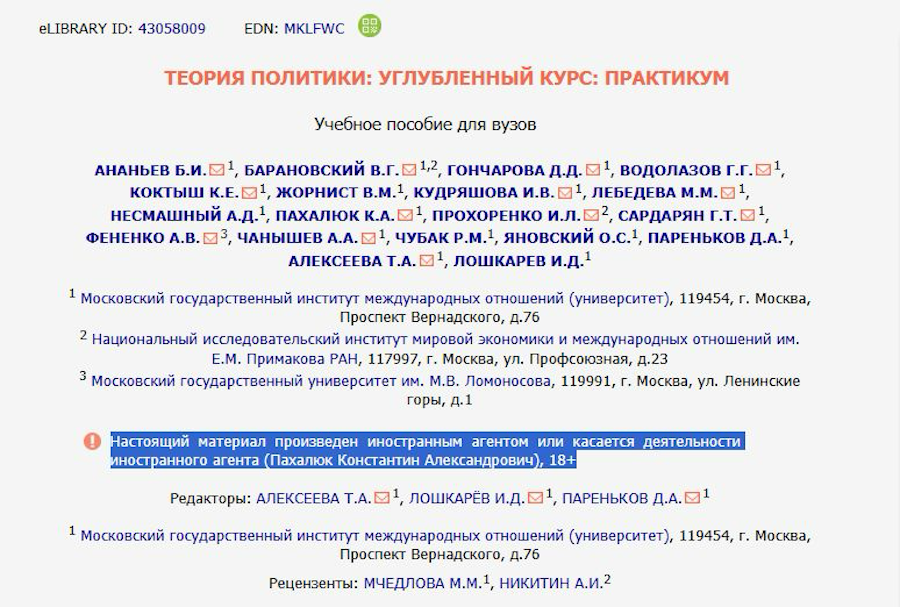
The Russian Science Citation Index (RSCI) database has begun deleting links to publications by scientists recognized as foreign agents: the title of the work remains, but it can no longer be downloaded, and a “foreign agent” label can no longer be placed next to their names (FIG. 1). Moreover, the terms of the competition for the publication of “socially significant literature” explicitly state that
“Authors, co-authors, compilers, academic and executive editors, authors of commentaries, prefaces, and afterwords, reviewers, illustrators, cartographers, and other persons participating in the preparation of the publication must not be ‘foreign agents’ in accordance with the Federal Law On Control over the Activities of Persons Under Foreign Influence.”
Paradoxically, is still possible for “foreign agents” to publish works within Russia; respondents cited successful examples of publications in Russian academic journals.
However, these publications will not only be difficult to read, but they cannot even be cited. The prohibition of references—in student papers, theses, and dissertations—to academic works by “foreign agents” has become a widespread practice in Russian universities. Alexandra Arkhipova asserts: “…students are generally forbidden from citing foreign agents altogether. A colleague of mine—who is preparing to defend her thesis—wrote to me explaining that references to me had been carefully expunged from her PhD dissertation…”
Although scientific work is not prohibited, it is virtually impossible in practice. As for scientific publications, some are still possible; publications by “foreign agents” are sold in a very limited number of venues.
The Transnational Nature of Repression: The “Foreign Agent” Status as a Problem Abroad
An unexpected discovery: “foreign agent” status also, to some extent, influences the behavior of members of the European and American academic communities. As reported by a “foreign agent” currently residing abroad, a research institution outside of Russia denied her an internship, citing the Board’s concern that the institution might “antagonize” the Russian authorities or provide positions to “problematic scholars” (7).
We received similar information regarding the same institution from another “foreign agent” (6). The fact that an employee of a European research institution had been designated a “foreign agent” proved to be a problem for the leadership: “colleagues…asked questions, not understanding what it was.” For this particular “foreign agent,” it was important “to explain to colleagues that my status poses no risks to them.”
Counterintuitively, therefore, the status of “foreign agent” can negatively impact the prospects of a Russian scientist who has left the country, particularly in situations where their leadership and colleagues have a limited understanding of transnational repression and may perceive such a status as a liability for their own institution.
***
The present study demonstrates that for a Russian scientist, researcher, or educator, the imposition of “foreign agent” status constitutes what is known as Berufsverbot: a ban on the practice of one’s profession.
This constitutes not only a gross violation of all academic rights and freedoms, but effectively “academic death”—a state in which it becomes impossible, within Russia, to exercise on equal terms any of the rights of “academic citizenship”: teaching, research, and scholarly publication.



0 Comments